The answer depends on how we use SwiftUI. For an app entirely written using it, one might argue that it gets released whenever the app finishes. But what about an UIKit app that uses some SwiftUI views?
To answer this question, let’s explore some scenarios involving environment objects. They have reference semantics, and we can track their instances using the memory graph.
If you wish to check the sample project, here’s the repository. It has different git tags for each scenario explored below.
Scenario 1: holding a View instance
Let’s begin our exploration by instantiating our RootView with some environment objects. We won’t attach it to the UI, but only store it in a variable in our view controller:
class MainViewController: UIViewController {
    var rootView: AnyView!

    override func viewDidLoad() {
        super.viewDidLoad()

        rootView = AnyView(
            RootView()
                .environmentObject(EnvA())
                .environmentObject(EnvB())
        )
    }
}
SwiftUI needs a way to bind these environment objects to a specific view. They will stay around as long as we hold the RootView instance. If we build the memory graph, here’s what it shows:
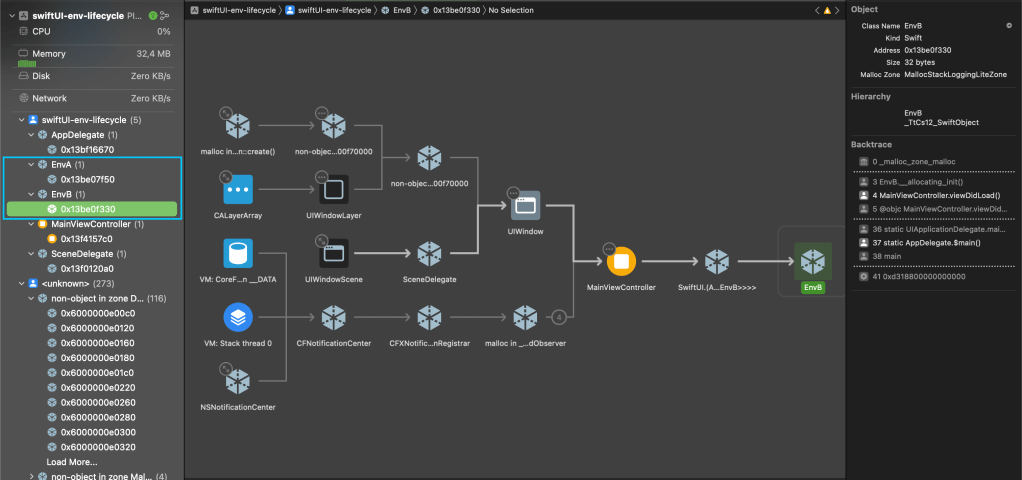
Notice the memory graph doesn’t show instances of SwiftUI views. These are structs, and have value semantics, not living in the heap.
Scenario 2: Holding a reference to a UIHostingController instance
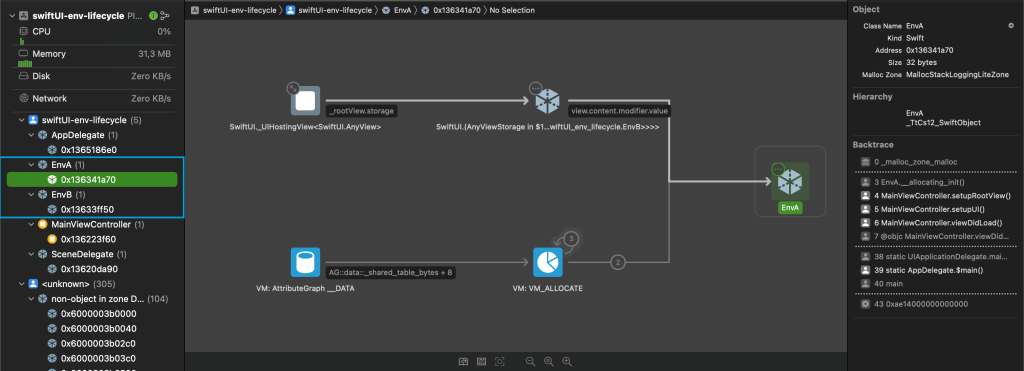
This is similar to the first scenario. If we hold a reference to a UIHostingController, the environment will still be around, as the controller holds the value of its root view. Notice this happens even after the SwiftUI views get removed from the view hierarchy:
@objc private func releaseRootView() {
    guard let rootViewHostingController,
          let hostingView = rootViewHostingController.view else {
        return
    }

    rootViewHostingController.removeFromParent()
    hostingView.removeFromSuperview()

    // Scenario 2: Keep holding a reference to the hosting controller.
    //self.rootViewHostingController = nil
}
The memory graph continues showing our two instances in memory:
Scenario 3: Having a UIView with a retain cycle
In this scenario, we explore UIViews used within a SwiftUI view tree. UIViews have reference semantics, and if an instance leaks in memory, the SwiftUI environment will continue alive:
final class LeakingUIView: UIView {
    private var retainingClosure: (() -> ())!

    override func layoutSubviews() {
        super.layoutSubviews()

        retainingClosure = {
            // Scenario 3: Having a retain cycle in a UIView.
            self.backgroundColor = .red
        }
        retainingClosure()
    }
}

struct LeakingView: UIViewRepresentable {
    func makeUIView(context: Context) -> LeakingUIView {
        LeakingUIView()
    }

    func updateUIView(_ uiView: LeakingUIView, context: Context) {}
}
When we release our hosting controller instance, we notice the environment is still being held due to references associated with the leaking view in memory.
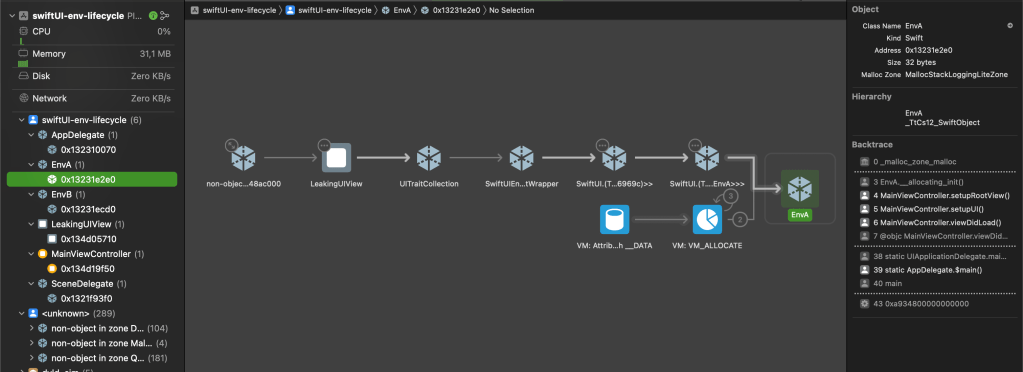
Here’s what the memory graph shows:
LeakingViewhas a reference aUITraitCollectionUITraitCollectionhas a reference to aSwiftUIEnvironmentWrapperSwiftUIEnvironmentWrapperhas references to its environment objects (EnvA,EnvB)
Scenario 4: Having a retain cycle between a UIView and an environment object
If we hold a reference to a UIView in one of the environment objects, and this UIView was inside a SwiftUI tree, we have a reference cycle:
struct SubView: UIViewRepresentable {
    @EnvironmentObject
    private var envA: EnvA

    func makeUIView(context: Context) -> SubUIView {
        let subView = SubUIView()
        // Scenario 4: Retain cycle between environemnt objects and view references.
        envA.someView = subView
        return subView
    }

    func updateUIView(_ uiView: SubUIView, context: Context) {}
}
After removing the SwiftUI views from the screen, here’s what the memory graph shows:
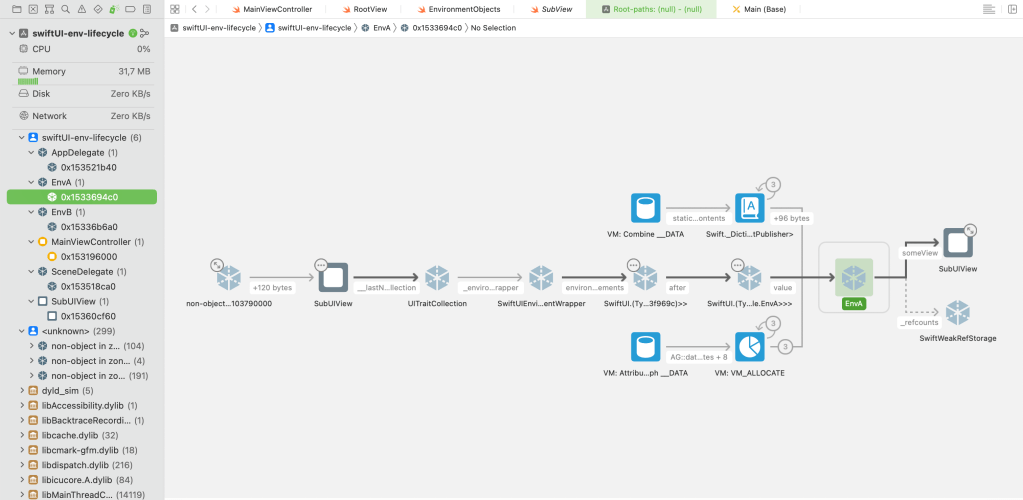
SubUIView and EnvASubUIViewhas a reference to aUITraitCollectionUITraitCollectionhas a reference to aSwiftUIEnvironmentWrapperSwiftUIEnvironmentWrapperhas a reference toEnvAEnvAhas a reference toSubUIView, and we can go back to the point 1 (a cycle)
Conclusion
Always make sure to:
- Dispose of any
SwiftUI Viewvalues not used anymore - Dispose of any
UIHostingControllerreferences not used anymore - Watch out for memory leaks in:
UIViewsused withinSwiftUI- references between your
UIViewsand your environment objects UIViewControllerspresenting theUIHostingControllers- the environment objects themselves
Environment objects can get complex depending on what your views need to accomplish. They might use a lot of computational resources, so it’s necessary to watch out for live instances when the underlying views get deallocated.

 Tiago Lopes